HOME / COMPANY / ABOUT
Filtration Engineering Built Around Real Process Requirements
Eco Plus Filters designs and manufactures gravity filtration systems for edible-oil dewaxing and winterization. The work starts with the plant: oil type, wax load, available cycle window and the space the system has to fit into. Everything after that — engineering, fabrication, testing, commissioning — follows from those conditions.
Eco Plus: an Indian engineering manufacturer
Eco Plus is an engineering and manufacturing company based at Prithala, District Palwal, Haryana. The group works across industrial fabrication, including pre-engineered buildings and EOT cranes, and through Eco Plus Filters supplies gravity filtration systems to the edible-oil industry.
Design, fabrication, assembly and testing are carried out at the company’s own works, and the same team supports installation and commissioning at the customer’s plant.
A specialist, not a general machinery supplier
Eco Plus Filters concentrates on one process stage: the separation of wax and stearin from winterized edible oil. That narrow focus is deliberate. Filtration behaviour changes with oil type, crystal habit, viscosity at filtration temperature and the way the maturation stage upstream is run, and a system designed without those inputs tends to underperform on the floor regardless of how it looks on paper.
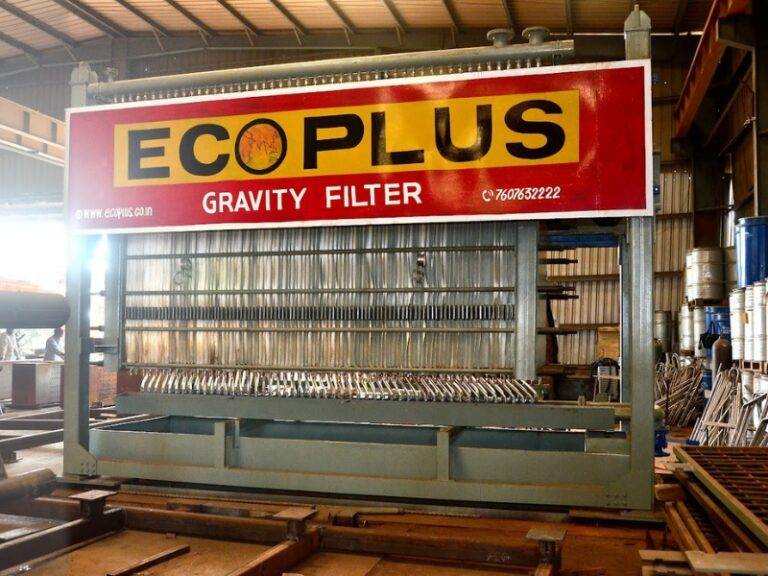
The company supplies the Eco Plus Automatic Gravity Filter to edible-oil refineries and processing plants, most commonly as a replacement for or an upgrade from conventional PP filter press installations.
Engineering philosophy
Four principles shape how a system is specified. They are also the questions we ask a plant before proposing anything.
Process before product
The oil and the plant define the system. A configuration is proposed only after the filtration duty is understood.
Low pressure by design
Separation at 0.1–0.6 bar keeps wax crystals intact instead of forcing them into the media.
Contain the handling
Closed filtration and contained discharge reduce open exposure, spillage and housekeeping load.
Automate the repetition
Sequenced cycles remove the repetitive manual steps that make batch results depend on the shift.
From design office to commissioned system
Select a stage to see what it covers.
STAGE 01 / 06
Application engineering
Every enquiry starts as a process question rather than a product selection. Oil type, wax load, filtration temperature, batch size and the available cycle window determine the filtration area and the cycle assumptions the system is built around.
- Process data review with the plant team
- Filtration area and cycle sizing
- Layout envelope and head requirement check
- Scope of supply and tie-in definition
STAGE 02 / 06
Design & detailing
General arrangement, mechanical detailing and the control philosophy are prepared together, so the sequence the panel will run and the hardware that has to execute it are settled before fabrication opens.
- General arrangement and service clearances
- Mechanical and piping detailing
- Control philosophy and sequence definition
- Material and media selection
STAGE 03 / 06
Fabrication
Structural work, chamber fabrication and welding are carried out in-house on food-contact grade materials, with inspection points defined against the drawings rather than left to final check.
- Material procurement with documentation
- Cutting, forming and structural fabrication
- Welding to defined procedure
- Stage-wise dimensional verification
STAGE 04 / 06
Assembly & controls
Mechanical assembly, piping, actuation and the control panel come together as one unit, so the sequence can be exercised before the system leaves the works.
- Mechanical and piping assembly
- Actuation and instrumentation fitting
- Control panel build and wiring
- Filter media fitting
STAGE 05 / 06
Testing & inspection
The unit is checked as a working system: cycle sequence, actuation, leak checks and panel function, with the inspection record kept with the equipment file.
- Functional cycle testing
- Control panel testing
- Leak and integrity checks
- Final inspection and documentation
STAGE 06 / 06
Installation & commissioning
Site work covers positioning, tie-in coordination, start-up on live oil and operator handover, including the first filtration batches where the cycle is tuned to the plant’s actual conditions.
- Erection and tie-in coordination
- Start-up on process conditions
- Cycle tuning against oil behaviour
- Operator training and handover
Checked at the stage where a fault is still cheap to fix
Inspection is distributed across fabrication rather than concentrated at dispatch. Material documentation, weld inspection, dimensional checks and functional testing each have a defined stage, and the records travel with the unit.
Material documentation
Traceability records for food-contact grade materials.
Weld inspection
Visual and dimensional checks against procedure.
Dimensional inspection
Verification against issued drawings at each stage.
Functional testing
Cycle sequence exercised before dispatch.
Control panel testing
Wiring, interlocks and sequence verification.
Final inspection
Documented sign-off with the equipment file.
Support does not end at dispatch
Installation, commissioning and the first production batches are where a filtration system is actually proven. Eco Plus stays involved through that period and afterwards.
Application consultation
Filtration duty assessed against your process data.
Installation
Erection and tie-in coordination at site.
Commissioning
Start-up and cycle tuning on live oil.
Operator training
Handover covering routine operation and cleaning.
Spares & service
Filter media, spares and troubleshooting support.
Tell us about the plant, and we will tell you what the filtration stage needs
Oil type, capacity, existing filtration method and available cycle window are enough for a first technical response.