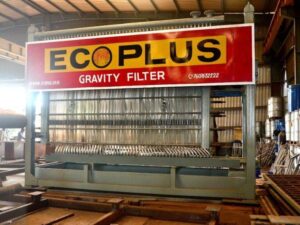
Gravity Filtration vs PP Filter Press for Edible Oil Dewaxing
Gravity filtration vs PP filter press compared for edible oil dewaxing and winterization: how each works, filtrate clarity, oil loss, labour, running cost and how to choose.
- By Eco Plus Filters Engineering
- Updated 2 Oct 2026
- 9 min read
Gravity filtration vs PP filter press is the main equipment choice a refinery makes for the filtration stage of dewaxing and winterization. Both separate wax or stearin crystals from chilled edible oil. They differ in how the oil is pushed through the filter, how the crystals are treated on the way, and how much manual work each cycle needs.
This article compares the two methods step by step: how each one works, what happens to the crystals, how filtrate clarity and oil loss compare, and what each means for labour, hygiene and running cost. It closes with a checklist for plants that are planning a new line or replacing an existing filter press.
- A PP filter press pumps oil into chambers between polypropylene plates; a gravity filter lets oil drain through the filter medium under its own head.
- Wax and stearin crystals are soft and break easily. Low pressure and low shear help keep them intact, which supports faster filtration and clearer oil.
- Filter presses are opened by hand to discharge the cake, which brings oil spillage, cloth handling and labour into every cycle.
- An automatic gravity filter runs the filtration and cake discharge cycle without operators at the filter.
- The right choice depends on oil type, capacity, cycle time, available height and how the crystallisation stage upstream is run.
What is a PP filter press?
A PP filter press is a plate-and-frame or recessed-chamber filter built from a stack of polypropylene (PP) plates. Each plate is covered with a filter cloth. The stack is clamped together hydraulically or mechanically, and a feed pump forces the chilled oil into the chambers between the plates.
The liquid oil passes through the cloths and leaves through channels in the plates. Wax or stearin crystals stay behind and build up as a cake inside each chamber. As the cake grows, the resistance rises, so the pump has to push harder to keep the oil flowing.
When the chambers are full, feeding stops. The press is opened, the plates are separated one by one, and the cake is scraped or dropped out. Cloths are inspected and washed at intervals, then the press is closed and the next cycle begins.
What is gravity filtration?
In gravity filtration, the oil flows through the filter medium under its own hydrostatic head instead of being forced through by a high-pressure pump. Crystals settle on the medium and form a cake while the clear oil drains below. The pressure difference across the cake stays low throughout the cycle.
In an automatic gravity filter, the steps that a filter press operator does by hand are built into the equipment: feeding, filtration, draining of the cake and cake discharge run in a timed sequence from the control panel. The filter stays closed during the cycle, so the oil is not exposed and no one has to work at the filter between batches.
Why the filtration step matters in dewaxing
In dewaxing and winterization, the oil is cooled slowly and held so that wax or stearin can grow into crystals large enough to filter. That crystallisation work can take many hours. The filtration stage then has to separate those crystals without undoing it.
Wax and stearin crystals are soft, temperature-sensitive and easily broken. Three things damage them during filtration:
- Pressure and shear: high-pressure pumping and sharp changes of direction break crystals into fines that can pass through the cloth or blind it.
- Temperature rise: if the oil warms during filtration, part of the wax dissolves and can crystallise again later in the bottle.
- Compression of the cake: a compressed cake has less open space, so filtration slows and more oil stays trapped inside.
How each filter handles these three factors is what separates the two methods in practice.
Gravity filtration vs PP filter press: side-by-side comparison
| Factor | PP filter press | Gravity filtration |
|---|---|---|
| Driving force | Feed pump pressure, which rises as the cake builds | Hydrostatic head of the oil; low pressure difference |
| Effect on crystals | Pumping and pressure can break crystals into fines | Low shear; crystals stay closer to their formed size |
| Cake | Compressed in closed chambers | Forms and drains without compression |
| Operation | Manual or semi-automatic; plates opened each cycle | Automatic sequence from a control panel |
| Cake discharge | Plates separated and cake scraped out by hand | Built into the automatic cycle |
| Oil spillage | Common when plates are opened | Filter stays closed; spillage avoided |
| Labour | Operators needed at every discharge | No operator needed at the filter during the cycle |
| Filter media | Cloths need regular washing and replacement | Media designed for the gravity cycle |
| Hygiene | Open handling of cake and cloths | Closed system during filtration |
Typical differences between a PP filter press and an automatic gravity filter in dewaxing and winterization.
Filtrate clarity and the cold test
The quality target for dewaxed oil is the cold test: the oil must stay clear for an agreed time at 0 °C. Oil fails the cold test when fine wax crystals pass the filter or when dissolved wax crystallises again after filtration.
In a filter press, the pump pressure that rises towards the end of each cycle can push fines through the cloth. Leaks at the plate joints and cloth damage have the same effect. Many plants recirculate the first filtrate until it runs clear, which adds time to each batch.
A gravity filter works at a low pressure difference from start to finish, so the crystals are not forced against the medium. The cake that forms on the medium also acts as a filter layer and traps finer particles as the cycle progresses. Eco Plus field experience is that filtrate from its gravity filters is clearer than oil filtered on horizontal pressure leaf filters and plate-and-frame presses.
Oil loss in the wax and stearin cake
Every filter cake holds some oil. That oil leaves the plant with the wax or stearin and is sold at a lower value or lost. The amount depends on how open the cake is and how well it drains before discharge.
Broken crystals pack tightly and hold more oil. Compressed cakes in closed chambers also drain poorly, and some oil is lost again as spillage when the plates are opened. In gravity filtration, larger intact crystals form a more open cake, and the cake has time to drain before it is discharged. For high-volume oils such as rice bran and sunflower, small differences in cake oil content add up over a year of production.
Labour, hygiene and safety
A filter press needs people at the filter for every discharge. Plates are heavy, the work is done at low temperature, and floors around the press become oily. Cloth washing adds further manual work and wastewater.
An automatic gravity filter removes most of this work. The cycle runs from the control panel, the oil is not exposed during filtration, and the area around the filter stays clean. Operators supervise the process instead of handling cake and cloths.
Energy and running cost
Comparing the purchase price of the two filters gives an incomplete picture. The total running cost of the filtration stage includes:
- Power for feed pumps and, in a press, the hydraulic closing system.
- Labour for every discharge, cloth change and clean-up.
- Filter cloths and their washing.
- Oil lost in the cake and through spillage.
- Rework of batches that fail the cold test.
- Downtime while the press is opened, cleaned and closed.
Gravity filtration does not need a high-pressure feed pump and removes most manual handling, which is where its running-cost advantage comes from. Plants should calculate these items with their own capacity, labour cost and oil price.
When a PP filter press still makes sense
A filter press remains a reasonable choice in some situations:
- Very small batch capacities, where filtration runs only a few times a week.
- Plants that use the same press for several products or for bleaching earth filtration.
- Short-term or temporary installations where capital cost is the main limit.
- Sites with no room for the height a gravity filter needs.
Where dewaxing or winterization runs every day at commercial capacity, the labour, oil loss and cold-test reliability of the filtration stage usually decide the comparison.
Upgrading from a PP filter press to gravity filtration
Many Eco Plus installations replace an existing filter press in a running refinery. A first technical review usually covers:
- Oil type and wax or stearin content, which set the solid load per batch.
- Plant capacity in tonnes per day and the number of batches.
- Crystallisation and maturation design, cooling profile and holding time.
- Filtration temperature and how it is held between maturation and the filter.
- Available height and floor space for the filter and its tie-ins.
- Cycle window available for filtration within the refinery schedule.
With these inputs, the filtration area, cycle time and layout can be sized around the existing line. You can see the equipment on the Eco Plus Gravity Filter page or download the product brochure.
How to choose the right filter
Use these questions to compare gravity filtration vs PP filter press for your plant:
- Does your oil pass the cold test consistently, or do batches need refiltering?
- How much oil leaves the plant in the wax or stearin cake?
- How many operator hours does each discharge and cloth change take?
- How often is oil spilled or the area cleaned around the press?
- Is filtration limiting the number of batches you can run per day?
If several answers point to the filtration stage, it is worth reviewing the alternatives with real plant data. For background on standard test methods, see the American Oil Chemists’ Society (AOCS).
Replacing a filter press or planning a new line?
Send your oil type, plant capacity and current filtration method. A filtration engineer will reply with a first technical view.
Frequently asked questions
What is the difference between gravity filtration and a filter press?
A filter press uses a feed pump to force oil through cloths between clamped plates. Gravity filtration lets the oil flow through the filter medium under its own head at a low pressure difference, which treats wax and stearin crystals more gently.
Is gravity filtration better than a PP filter press for dewaxing?
For daily dewaxing and winterization at commercial capacity, gravity filtration usually gives clearer oil, less oil loss in the cake and much less manual work. A filter press can still suit very small or multi-purpose installations.
Why do wax crystals break in a filter press?
Pumping, rising pressure towards the end of the cycle and changes of flow direction apply shear to the crystals. Broken crystals form fines that pass the cloth or blind it and make the cake hold more oil.
Does a gravity filter need operators?
An automatic gravity filter runs filtration, draining and cake discharge in a timed sequence from the control panel. Operators supervise the process but do not need to work at the filter during the cycle.
Which oils can be filtered with a gravity filter?
Gravity filters are used in the dewaxing and winterization of sunflower, rice bran, corn, cottonseed, soya bean, palm, sesame and safflower oil.
Can an existing filter press be replaced by a gravity filter?
Yes. Most projects start with the oil type, capacity, crystallisation design, filtration temperature and available height, and the gravity filter is sized and laid out around the existing line.