Rice Bran Oil Dewaxing Process: Complete Guide for Edible Oil Refineries
A practical guide to the rice bran oil dewaxing process: controlled cooling, wax crystallization, filtration, common problems and how to choose a filtration system.
- By Eco Plus Filters Engineering
- Updated 2 Oct 2026
- 8 min read
Rice bran oil contains naturally occurring waxes that can affect its appearance and clarity after refining. Even when the oil has passed through other refining stages, these waxes may crystallize at lower temperatures and create a cloudy or hazy appearance.
This is why the rice bran oil dewaxing process is an important step for refineries producing clear and commercially acceptable refined rice bran oil.
Dewaxing is not simply about passing oil through a filter. Successful wax removal depends on controlled cooling, proper crystal formation, suitable holding conditions and efficient filtration. If any of these stages is poorly controlled, wax removal can become difficult and valuable oil may also be lost with the separated wax.
This guide explains how rice bran oil dewaxing works, why filtration matters and how modern filtration systems can help edible oil refineries improve process consistency.
What Is the Rice Bran Oil Dewaxing Process?
The rice bran oil dewaxing process is designed to remove waxes and other high-melting components that may cause refined oil to become cloudy when stored at lower temperatures.
Rice bran oil naturally contains waxes originating from the outer layers of rice grain. During processing, some of these waxes remain in the oil.
At normal processing temperatures, the wax may remain dissolved and therefore cannot simply be filtered out effectively.
The basic principle of dewaxing is straightforward:
Cool the oil → allow wax crystals to form → separate the crystals through filtration.
Although the principle sounds simple, industrial dewaxing requires careful process control. Cooling too quickly, insufficient crystallization time or inefficient filtration can affect the final result.
Why Does Rice Bran Oil Need Dewaxing?
One of the most visible problems caused by residual wax is haze or cloudiness.
Oil may appear clear immediately after refining but develop visible haze when exposed to lower temperatures. For packaged edible oil, this can create an undesirable appearance even when the oil itself remains usable.
An effective rice bran oil dewaxing process helps refineries achieve:
- Improved oil clarity
- Better visual appearance
- More consistent product quality
- Efficient removal of crystallized wax
- Better downstream processing and packaging consistency
The objective is therefore not merely to “filter the oil.” The refinery must first create conditions that allow dissolved wax to crystallize into particles that can be efficiently separated.
Step-by-Step Rice Bran Oil Dewaxing Process
1. Oil Preparation
Before dewaxing begins, the oil should be in an appropriate condition for controlled processing.
The exact point at which dewaxing is integrated into a refinery depends on the overall process design. Oil condition, wax content, upstream treatment and the required finished-oil specification can influence the operating sequence.
Stable feed conditions make the subsequent cooling and filtration stages easier to control.
2. Controlled Cooling
Cooling is one of the most important stages in dewaxing of rice bran oil.
At higher temperatures, wax components can remain dissolved in the oil. As the temperature decreases, their solubility reduces and crystallization begins.
However, simply making the oil cold as quickly as possible is not necessarily the best approach.
Controlled cooling encourages the development of wax crystals that can subsequently be separated by filtration. Excessively rapid or poorly controlled cooling may result in crystal characteristics that make filtration more difficult.
The appropriate cooling profile should therefore be established according to the refinery’s oil characteristics and process requirements.
3. Wax Crystallization and Maturation
Once the required cooling conditions are reached, sufficient time must be provided for wax crystals to develop.
This stage is sometimes underestimated.
Effective filtration depends heavily on what happens before the oil reaches the filter. If wax remains dissolved or the crystals are unsuitable for separation, even a capable filtration system may struggle to deliver the expected result.
The refinery therefore needs to control parameters such as:
- Cooling rate
- Final oil temperature
- Holding time
- Agitation
- Feed consistency
- Crystal development
Rather than relying on a universal temperature or holding-time figure, these parameters should be optimized for the actual oil and plant configuration.
4. Filtration of Crystallized Wax
After crystallization, the oil contains solid wax particles that need to be separated from the liquid oil.
This is where rice bran oil filtration becomes critical.
The filtration system should allow the clarified oil to pass while retaining the crystallized wax. Good filtration is also about maintaining stable operation without creating unnecessary oil loss, excessive manual handling or frequent production interruptions.
Traditional filtration arrangements can involve significant operator intervention depending on plant design.
Modern automated filtration systems provide refineries with another approach to handling this separation stage.
Role of Gravity Filtration in Rice Bran Oil Dewaxing
A gravity-based filtration system can be used to separate crystallized wax from rice bran oil after the cooling and crystallization stages.
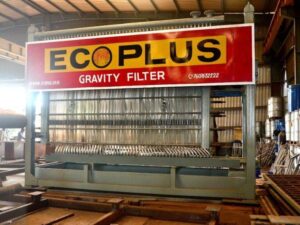
The Eco Plus Automatic Gravity Filter is designed for edible-oil dewaxing and winterization applications. Its enclosed, automated filtration approach is intended to reduce the manual handling associated with conventional filtration while supporting consistent wax separation.
For refinery operators, important operational considerations include:
Automatic operation: Reducing repetitive manual intervention can simplify filtration management.
Enclosed processing: A closed filtration environment can help reduce oil handling and spillage compared with open manual operations.
Automatic wax discharge: Efficient discharge can reduce the handling required after wax accumulates on the filtration surface.
Self-cleaning operation: Automated cleaning can help prepare the filtration system for subsequent operating cycles.
Lower utility dependence: Gravity-based filtration can reduce reliance on continuously maintaining high filtration pressure.
These factors become particularly relevant in plants processing oil continuously and looking to reduce labour-intensive filtration activities.
Dewaxing vs. Winterization: Are They the Same?
Dewaxing and winterization are closely related, which is why the terms are sometimes used interchangeably.
Both processes involve cooling oil so that higher-melting components crystallize and can be removed through filtration.
In practical edible-oil processing, the exact terminology and process conditions can vary depending on the oil, target specification and refinery design.
For rice bran oil processors, the key objective remains the same: create suitable crystals under controlled conditions and remove them efficiently without unnecessarily sacrificing valuable oil.
Common Problems During Rice Bran Oil Dewaxing
Even a well-designed plant can experience problems when cooling, crystallization and filtration are not properly coordinated.
Oil Remains Cloudy
Residual haze can indicate incomplete crystallization, inadequate filtration or process conditions that allowed some wax to remain in the oil.
Slow Filtration
Poor crystal formation can create a difficult filtration load. Feed conditions and the accumulated filter cake can also influence filtration performance.
Excessive Oil Loss with Wax
Wax discharge may retain some oil. The filtration process should therefore focus not only on wax removal but also on avoiding unnecessary loss of saleable oil.
Frequent Operator Intervention
If filtration requires repeated manual cleaning, cake handling or process adjustments, labour requirements and downtime can increase.
These problems illustrate why dewaxing performance should be evaluated as a complete process rather than treating the filter as an isolated machine.
How to Improve Rice Bran Oil Dewaxing Efficiency
Refineries looking to improve their rice bran oil dewaxing process should examine the entire process chain.
Start by maintaining stable feed conditions. Establish a controlled cooling profile rather than relying on aggressive temperature reduction. Allow sufficient time for crystal development and ensure agitation supports rather than disrupts crystallization.
Most importantly, match the filtration system to the characteristics of the crystallized wax and the plant’s required throughput.
Automation can also help reduce process variation caused by repeated manual operations.
The goal should be a balanced process where cooling, crystallization and filtration work together.
Choosing a Filtration System for Rice Bran Oil
Before selecting a filtration system, refinery operators should consider:
- Required processing capacity
- Oil characteristics
- Wax concentration
- Operating temperature range
- Available floor space
- Labour requirements
- Utility consumption
- Cleaning requirements
- Wax discharge method
- Maintenance requirements
- Integration with existing refinery equipment
A filtration system should not be selected purely on initial equipment cost. Long-term operating requirements, manpower, cleaning frequency, oil handling and process downtime should also be evaluated.
Conclusion
The rice bran oil dewaxing process plays an important role in producing clear, visually consistent refined rice bran oil.
Successful dewaxing depends on much more than filtration alone. Controlled cooling allows wax components to crystallize, adequate maturation develops filterable crystals, and an efficient filtration system then separates those crystals from the oil.
For modern edible oil refineries, improving this process can mean looking beyond conventional manual filtration methods toward more automated and enclosed solutions.
The Eco Plus Automatic Gravity Filter is designed for applications such as rice bran oil dewaxing and winterization, with automatic filtration, wax discharge and self-cleaning operation.
When cooling, crystallization and filtration are properly integrated, refineries can build a more controlled and efficient approach to rice bran oil dewaxing.
Planning rice bran oil dewaxing?
Send your oil type, plant capacity and current filtration method. A filtration engineer will reply with a first technical view.